Cosmesis
Like most people my age, I have my share of scars. I also get my medical care in a teaching facility, which means that I often run into people who find it edifying to look at those scars. It took a while to accept this. It’s like: excuse me, there’s a person here … But eventually I decided to lean into it. Scars are, after all, part of being a person, and why shouldn’t they learn from the best?
A medical resident was examining me recently and discovered an older scar. “Beautiful cosmesis! Who did that? I mean – if you don’t mind. Sorry. But who …?”
“Cosmesis.” It's a word I'd never heard before. Collins dictionary defines it as “the practice of preserving or restoring physical appearance, usually after an operation conducted for non-cosmetic reasons.”
Have I got cosmesis! I can boast a vintage Hiraki ca 1986, and a 2009 Liu, both extremely elegant. My 2026 Lim is also impressively placed, and is well along the way to doing what it’s designed to do: namely, disappear. My 2026 Au (actual name of the doctor who performed one of my biopsies) is my least attractive scar. But it did the trick of making sure I got an early diagnosis. I’m learning to love it.
These days, I’ve been thinking about the cosmetic aspect of everything I’ve been going through. Weirdly, I face inhabiting the stereotypical image of cancer patient at a time when I no longer have cancer. “Having cancer” in my case means being treated for it. And that means hair loss.
But the image is outdated. Some people never lose their hair with chemo. Some cancer patients never get chemo. I wonder what percentage of people being treated for cancer have no visible evidence. And afterwards? This experience will leave few marks in my case. I have my 2026 Au and Lim to prove I’ve had breast cancer, but my radiation tattoo may be temporary. And I may not lose my hair at all.
To some extent, cancer free-appearance is something you can buy. The scalp-cooling technology that I am using costs a tidy sum though it is covered under some workplace insurance plans. A good wig will set you back just as much. A lot of hospitals in England offer scalp-cooling as part of the cancer treatment, and I hope that comes here soon.
This journey has forced me to reconsider my relationship with my appearance. Focusing too much on the outside has always felt like a dangerous trap for me as a woman, a gateway to unchecked consumerism and a no-win obsession with staying young. I don’t want to be judged on my appearance in a way that overshadows everything else I can give to the world. But this year, I’ve gained new respect for attending to the surface of things.
It’s been a lot more fun to go down cancer-fashion rabbit holes than ones that deal with survival statistics and long-term side effects. Normally, I skip the websites of influencers, but I have so much admiration for the ones who share their experiences online. They’re young and they have cancer, and they’re out there talking about how to feel a sense of control in the treatment maelstrom.
Also smart. Check out this post from Krista Rodriguez on eight things not to say to someone with cancer. (By the way these would not be my top eight, but I appreciate her wit.) Here’s Leila Esmaeili on making making meaning from her experience by sharing it with others.
As I approach 70, my friends have seen some sh*t, and an "organ recital" forms at least 20% of every conversation. My contribution at the moment happens to be the ups and downs of chemotherapy. What are Krista’s and Leila’s friends talking about? It must be lonely to go through this as a young person. And scary in a way I can barely imagine. There is so much to lose.
Some women are choosing to “go flat” after having a mastectomy. Sometimes, they have the surgery because they have cancer, but some women with the genetic markers for hereditary cancer have preventative double mastectomies, and they have them young. Some choose to post photos, demonstrating the “aesthetic flat closure” that leaves them with a smooth, flat chest. Not all cosmetic surgery is about reconstruction, I've learned. Some even get tattoos, and share pictures of them on the internet.
That sharing is an act of tremendous generosity. During the period when I wondered if I carried the gene (I don’t), these photos made me realize that a mastectomy can be a canvas for self-expression. I’m also impressed with how non-judgmental these women are of different choices. Some may get reconstruction; some may choose to “go flat.” A lot of sites show pictures of women with and without flat chests, together and thriving.
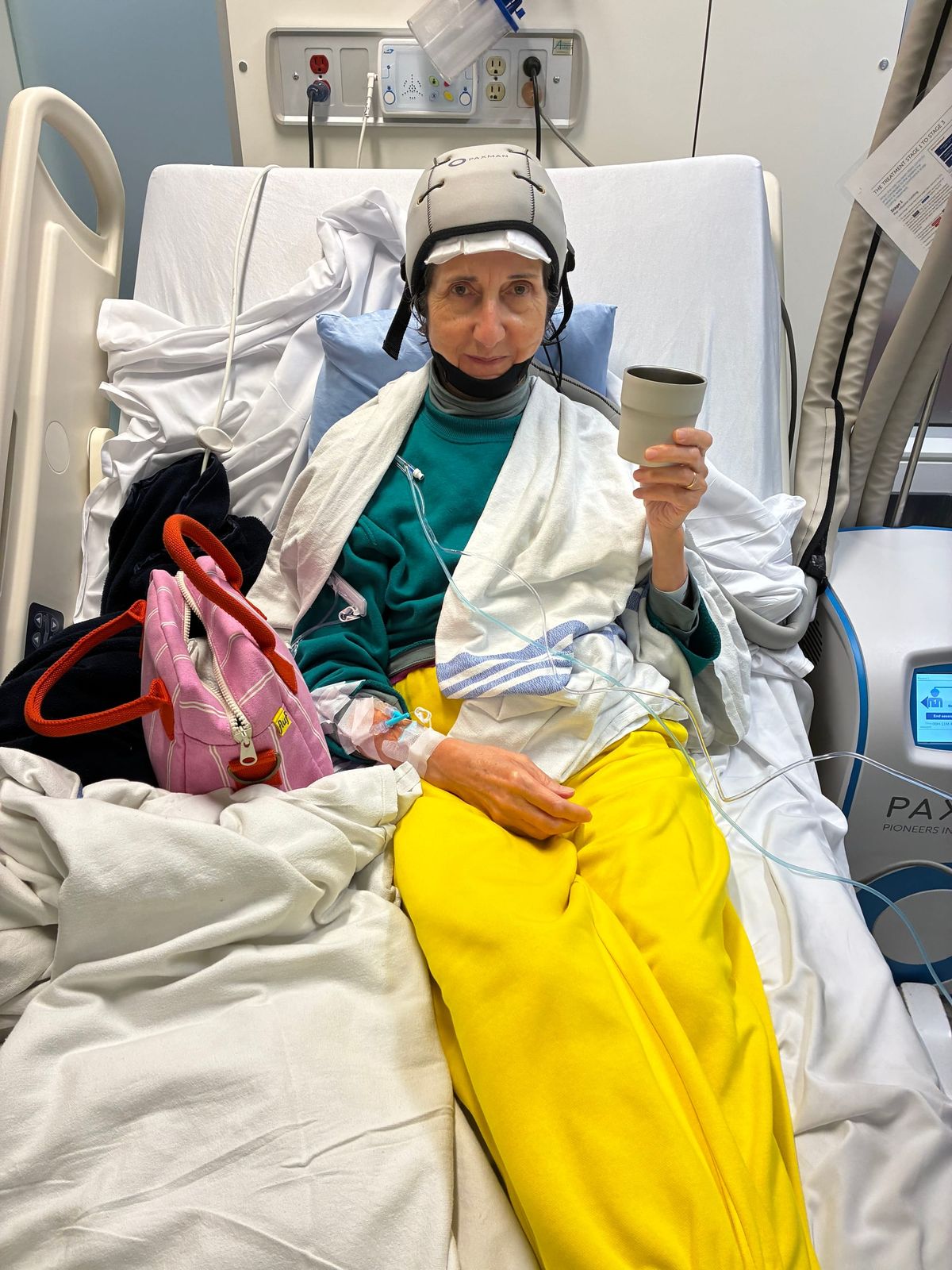
The scalp-cooling experience has been bizarre and fascinating in its own way. Every week, I wear a refrigerated cap which protects my hair follicles from the chemo drugs. I’ll likely lose some, but not all of my hair. The whole procedure is elaborate. Here in Toronto, it’s supported at Princess Margaret hospital, and I can't imagine how it would work, otherwise. You have someone come in, wet your hair, put some slippery goop on it, and fit you with the cap, which resembles an old-fashioned football helmet. At some point, they flip a switch, the cap inflates, and your head gets very, very cold.
I was terrified of losing my hair and welcomed the idea of scalp-cooling. Later, I became ambivalent. It means more time in the hospital while you wait for your head to get cool enough, then keeping it on for two hours after the infusion stops. And you don’t always keep your hair. I can understand why someone might just let it go and start anew.
But the whole experience has made me feel so cared-for, and my doctor himself recommended it, underlining that with the medications he’s giving me, I have a good chance of keeping a lot of hair with the cap. It promotes quicker re-growth as well. The more it's used, the better the technology and techniques will get. I'd like to see it become a familiar part of chemotherapy. I decided to give it a try.
People say scalp-cooling gives them the sense of control. I have to say that is not my experience. At first, anyway, it was yet another unknown. Would I get a massive headache? Would it make me dizzy? Where hair loss would be a certainty without it, I still don’t know how much is going to fall out. But having started the process, I get it now. You don’t just go in and get that thing put on your head for four hours. You also have to look after your hair in elaborate ways in the meantime, and I wonder if that’s part of the appeal. You have to comb it a certain way, wash it in a certain way. As Leila puts it, you have to treat your hair "like glass."
Starting chemo has been scary. Scalp-cooling literally pulls my thoughts from the from inside my anxiety-ridden head, to the surface. There’s even a mindfulness technique where you focus on your senses. Freezing my hair-roots brings some fairly strong sensations! Okay, all this is “just” a distraction, but I’ve gained new respect for distractions, these days.
Maybe that’s why the week before starting chemotherapy, I focused on inventing my chemo-clinic look. I got Barbie-core insulated lunch bag (more on that later), and some Value Village finery: yellow sweat pants with contrasting-coloured shirts. Rolf cut the cuffs off so the sleeves could be rolled up. The nurse who helped me through a scary blood pressure spike the first week instantly got it. While two doctors had bent over me, shouting in my face how dangerous it was to have my blood pressure so high, she said: “Love your outfit!" and handed me a calcium channel blocker.
I'm sure it was the pill and not the kind remark that brought my pressure down, but at a time like that, it was so good to remember there was – and is – more to me than a series of numbers displayed on a machine.
Comments ()