The School of Chemo Lesson 2: How are you?
That’s a question I hear a lot these days. It makes me think of my dear friend Gita Schwartz. Gita died of cancer in 2024 (though medical science had given her many more years than anyone expected, during which she held several jobs making sure people were housed who otherwise might not have been housed, and during which she laughed, traveled, danced, sang, mentored young people, sculpted in stone and made friends with mushrooms and bees). Anyway, in her last year, Gita made me realize how often I say: “How are you?” automatically, without thinking. Never one to mince words, she’d reply: “I have cancer. Can we talk about something else?”
For my own part, I don’t mind rattling off my latest crop of chemo symptoms. I’m not in Gita’s situation, though. All indicators tell me that this difficult phase will come to an end before too long. I get to lean in to these moments of sharing, relatively confident that in a year’s time, there really will be something else to talk about. I sense how connections are strengthened when I share what’s going on. And after all, cancer is there, in the room when I spend time with people. I’d rather get the “organ recital” out in the open and move on.
When I'm the one asking the question, some people are hesitant to talk about their own troubles. So far, it hasn’t bothered me when they do. After all, would I want to find out later? I might be a bit less patient if a friend is going around in circles about a problem they can’t do anything about (see “moving on” above), but lately, I’ve been honoured with a lot of confidences. They come from close friends, but also from people I’m not normally on organ-recital terms with.
There’s a lot of cancer out there, and despite the recent (welcome) trend of overcoming stigma, there still don’t seem to be enough opportunities to talk about it. My own diagnosis opens a door for people to tell me about their experiences with cancer, their friends’ and family’s experiences with it. Come to think of it, they tell me about whatever is making them feel vulnerable these days. It’s not a bad thing to share that level of intimacy with people. To ask: “How are you?” and be open to hearing a truthful answer. To hear a truthful answer.
Sharing symptoms, or hearing about them can be complicated. If you're my age or close to it, you've probably found yourself in the midst of that conversation. The chatty and intimate "organ recital" becomes a mind-numbing litany of woes. The exchange of complaints takes on an almost competitive quality. It’s as if the walls were closing in. Maybe you chipped in a few night sweats and knee pains at the start, but now, you want out of the game. You want to scream: There's a world out there! Let’s talk about something … anything … outside of our own skins!
When does the person honestly answering: “How are you?” turn into that person? The one whose ailments become … what? A language, a whole way of being in the world. I'm always afraid I'll cross that line, and maybe Gita was, too.
I try to be especially careful talking to people who are younger than me, who might not have seen a lot of cancer treatment in their lives. I don’t have the energy to hide my story, honestly. That’s why I talk about it, but I also like to think I can help diffuse the fear of ageing and its attendant diagnoses by being matter-of-fact about mine. I just hope it's not having the opposite effect.
My mother had systemic lupus. She used to talk to me about her symptoms with what seemed at the time like relish. I didn't get the opportunity to ask: "How are you?" because she often launched into a barage of complaints before I could even get my coat off. I wanted to ask. I wanted a chance to tell her I was ready to listen.
But now I've had a glimpse of what it's like to have ailments crop up unpredictably, to wonder each morning what fresh unpleasantness my body is going to offer today. It's scary. For her, there was no end in sight. I used to tune her out, but she couldn't tune out what the disease was doing to her. Now, I wish I had been more compassionate. I felt attacked because I thought she was expecting me to do something about it. I'd rather have believed that than acknowledge there was nothing either of us could do.
My mother and I had some baggage, but most of the time, I want to hear people's health-related stories. I learn a lot. The main revelation, which continues to astound me: everyone’s different.
People who work with cancer patients understand that, and I think it’s part of what makes them so special. They know that someone could have the same diagnosis as me, be in the same demographic, have the same treatment protocol and have a completely different set of reactions. What a privileged insight these people have into the diversity of human experience!
They ask "How are you?" and prompt for details that would bore the hell out of anyone else: "These sensations in your feet, are they on the top or on the sole? Would you describe them as sticking? Stabbing? Prickling?" It's bizarre to have someone that smart and accomplished take such a profound interest in my aches and pains. It's an almost literary fascination. There's a story being told in my blood counts and the pains in my feet, and these doctors really, really want to know what happens next, and how changing a dose by ever-so-little will affect the outcome. I have to remind myself that not everyone is going to listen with such rapt attention.
But speaking of privilege. (I think I’ve said this before but it deserves to be said again.) Bodies are different, but so are lives. I’m fortunate in that I had an early catch, therefore low-dose chemotherapy. But having an opportunity to look after myself really contributes to my mostly positive answers to: "How are you?"
Unlike when I was younger, I don’t have anyone depending on me to be their caregiver right now. I have been able to arrange my work to suit my strange body-clock and my spates of mental blurriness. What if I were doing shift work? Gig work? What if I didn’t have this safe, happy home to return to after my treatments? Being white, I don’t have to work hard to convince medical practitioners to take my pain seriously. I hear: "Don't be afraid of bothering us, it's what we're here for."
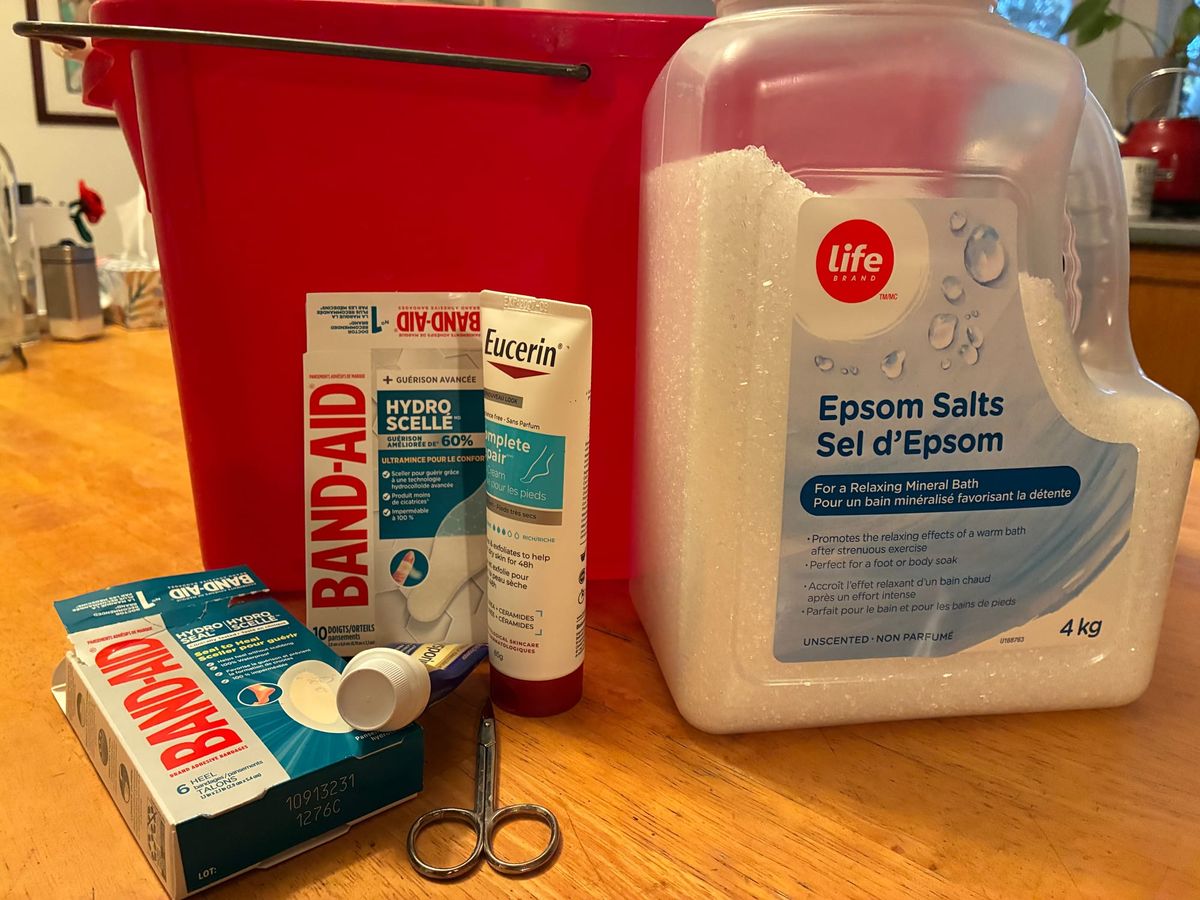
Lately, my feet are a mess. It's not fun, but I can elevate them any time I want – unlike warehouse workers, cashiers, wait-staff. I can see a chiropodist, go to a nearby drug store and get five different kinds of bandages to see which will stay on without hurting my thin skin. Turns out the ones I need cost about a dollar a piece. You do the math. I can get a pair of shoes especially to see me through the next six months, when neuropathy is expected to be at its worst. I can walk safely around my neighbourhood whenever my body tells me to get up and move. And people here know me, and ask me how I'm doing.
When I need to eat, I eat. Whatever I feel like. Clams! Okay, clams. Grapes! Okay grapes. No, don’t want the grapes after all. I want pears. Listen to your body. So say chemo-advice websites. Not so easy if you have to depend on a food bank.
"How are you?"
Lately I can’t answer: "Great." But I can say: "Holding my own." Like a child, I'm proud of my "accomplishment" and want/expect praise from doctors, friends, even strangers. I am doing well. But I’m also well done-by.
Another answer that comes to mind these days is: "Better than before I got my diagnosis." The waiting is the hardest part. People have told me that from day one and – unfortunately – I’ve already had occasions to say it to others. When I talk to people who had cancer ten, twenty, thirty years ago, that period awaiting diagnosis is often the most vivid in their memories, and I daresay the most scarring. It comes to my mind a lot these days, as the end of chemotherapy is on the horizon. Though more and more phases of treatment remain, there is a kind of full-circle feeling, taking me back to when this journey started. For the months of waiting, a lot of people asked: “How are you?” automatically. Never suspecting it might be a fraught question. And the answer was often a lie.
But that’s the topic for another blog post.
Comments ()